Thursday, March 31, 2011

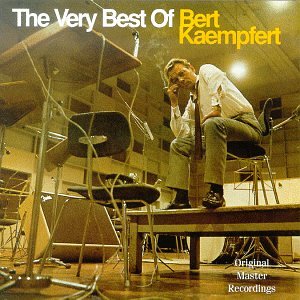
Bert Kaempfert

Bert Kaempfert This would be another of those “other people’s greatest hits” – he does songs by Sinatra, Al Martino, Nat King Cole, Wayne Newton – but for the fact the Kaempfert actually wrote these songs, co-wrote them actually; someone else wrote the words.

You can look him up on Wikipedia to get a list of his impressive musical accomplishments. But what the article doesn’t say is that Kaempfert was the first to record The Beatles. He used them as a backup band for second string singer Tony Sheridan, while they were in Hamburg. He let them do two songs without Sheridan – Ain’t She Sweet with John singing, and Cry For A Shadow, an instrumental.


The album, The Very Best Of Bert Kaempfert, is a double, and it has 7 of the 11 songs that made the Billboard top 100. It has been reissued on CD with a shorter running order.


Bert Kaempfert:


  • Strangers In The Night – This could be taking place in a singles bar, but that would take all the romance out of it. This K original single-handedly rejuvenated Frank Sinatra’s career in 1966.
  • Red Roses For A Blue Lady – The song was written in 1948 and was a hit by Vaughn Monroe. Winter of 1965 saw three competing versions: one by Vic Dana, one by Wayne Newton, and this one. Odd that K’s biggest hits were songs he did not write. I did not understand, being 8 years old and hearing this, why the lady was blue. I did not know then that “blue” meant “sad.” This is, in any event, great ballroom stuff.
  • Lady – Back to originals here. A hit for Jack Jones in 1967. Not the Styx song.
  • Bye Bye Blues – From the winter of 1966, very jaunty. Bye bye blues indeed.
  • Wiederseh’n – Goodbye by any other name…
  • L-O-V-E – Love in the abstract and love by letters, a hit for Nat King Cole in 1964. It’s better without the words.
  • Remember When (We Made These Memories)
  • The World We Knew (Over And Over) – Another one that Sinatra ran away with. That was in the summer of ’67.
  • That Happy Feeling – Tell me about it…From the summer of 1962.
  • Three O’Clock In The Morning – Another hit that he didn’t write, from the spring of 1965.
  • Caravan – By Duke Ellington. This song took on a life of its own, with versions strung as far afield as Nat King Cole (with words) on one end, to The Ventures on the other. Not the Van Morrison song.
  • Danke Schoen – You’re welcome. Another of K’s creations, this one became Wayne Newton’s signature song, in the summer of 1963.
  • Spanish Eyes (Moon Over Naples) – And they keep on coming. This one was a hit for Al Martino in the summer of ’66, and it was recorded by thousands. The original was a hit in the summer of 1965.
  • Hold Me
  • Sweet Maria
  • Hold Back The Dawn – I used to have a version of this by Al Jurreau.
  • Afrikaan Beat – It’s been suggested that this was the beginning of World Music. Maybe. From the winter of 1962.
  • Wonderland By Night – His first and biggest hit. He had competition from Louis Prima (a similar trumpet arranged recording) and from Anita Bryant (with words) but K won hands down, his version reaching number 1 in the winter of 1961. I Can’t Help Remembering You
  • You Are My Sunshine – He gives it his best effort but it’s still You Are My Sunshine.
  • Balkan Melody
  • Steppin’ Pretty
  • A Swinging’ Safari – A winner. Billy Vaughn did a note for note copy and put the song into the top 20 in 1962.

Monday, March 28, 2011

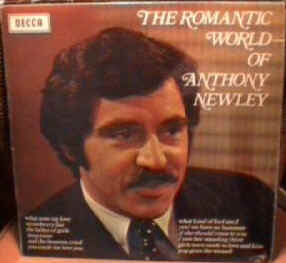
Anthony Newley

Anthony NewleyI suppose that romance is in the eye of the beholder, or better, in the heart of the beholder. And we all have different ideas of what romance is. And for our purposes, we all have different ideas of what romantic music is. Now that’s a topic that deserves a blog post of its own.
We also have ideas of what romantic music isn’t. And for my money, and to my ears, Anthony Newley, whatever his music is, it isn’t particularly romantic.

I say that because I found this LP, a collection of his hits and misses, which is part of the “The World Of…” series. (I have The World Of Ray Charles, for example, and The World Of Cat Stevens). But his is titled The Romantic World Of Anthony Newley. So I suppose that his world may be romantic. But, as I say, his music isn’t especially, the album title nothwithstanding.

Newley was English. He is someone to whom others are compared. David Bowie, for one, in his pre-Space Oddity days, is often compared to Newley. He put 10 songs on the UK top 20 between 1959 and 1961, one of which reached number 1 (Why) and three of which are on this collection, and 4 songs in the Billboard top 100 between 1960 and 1962, none of which reached higher than 67 and three of which are on this collection.


Anthony Newley:


What Now My Love – A 60s standard. My favourite version may just be the one by Miss Piggy.
Strawberry Fair – This is kind of nursery rhyme but it’s just a bit bawdy. From the fall of 1960.
The Father Of Girls – There are more songs about being a son / daughter than about being a parent, and this is why. Is so hard not to be maudlin.
Deep River
And The Heavens Cried
You Made Me Love You – The Tin Pan Alley standard. Listen to Harry Nilsson’s version.
What Kind Of Fool Am I – A bit hit by Sammy Davis Jr, a small hit by Robert Goulet, and a smaller hit by our hero. From the fall of 1962.
Yes We Have No Bananas – Honest, he really does this song…
If She Should Come To You – A hit in England in the summer of 1960, and in NA in the fall.
I Saw Her Standing There – The only other cover of this that I know of is the one by Elton John and John Lennon. This has to be one of the worst Beatles covers I’ve ever heard.
Girls Were Made To Love And Kiss – Gloria Steinem’s favourite song, I hear…
Pop Goes The Weasel – This is a song about Pop Goes The Weasel as much as it is Pop Goes The Weasel. From the winter of 61 / 62, though it hit in UK half a year earlier.

Sunday, March 27, 2011

James Hurst

James Hurst was a novelist but I don’t think this was him. It may have been, though, because the author had some kind of musical career prior to his becoming an author. I question it, though, because him musical career was said to be of the operatic variety.

Whoever he was, this James Hurst was in at least one Broadway musical, a Noel Coward play called Sail Away, and no James Hurst has an entry in Wikipedia.

That’s the thrill of second hand shops; you pick up random singles like this and then you’re left to puzzle over them for years….


James Hurst:

Something Very Strange – Another song about falling in love, from the musical Sail Away, in which Hurst performed.

Saturday, March 26, 2011

André Kostelanetz

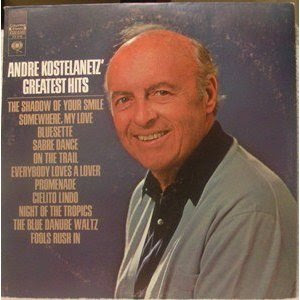
André KostelanetzI was sitting at work innocently listening to a collection of tracks by The Tornadoes, when Tim The Enchanter, who is our sysadmin, made a comment.. “That’s elevator music, man,” he said.

Tim The Enchanter knows how to fix a server, but he doesn’t know squat about elevators.

Now André Kostelanetz, that’s elevator music….

Kostelanetz, he never had an actual hit, so I don’t know what business he had having a Greatest Hits album but have one he did…

André Kostelanetz:


Bluesette – I don’t have any other versions of this, though apparently Ray Charles did it.
The Shadow Of Your Smile – A 60s lounge favourite.
Lara’s Theme – aka Somewhere My Love, from Dr. Zhivago, a hit for The Ray Conniff Singers in 1966.
Everybody Loves A Lover – A hit for Doris Day et al
Night Of The Trumpets
Promenade
Calito Lindo – I think this is Mexican. Frito’s used this ages ago in an ad – Aye aye aye aye, I am the Frito bandito… they got a lot of heat for it.
The Blue Danube Waltz – A truncated version of the Strauss waltz
The Grand Canyon Suite – a truncated version of Ferd Grofé’s American classic
Fools Rush In – The Tin Pan Alley standard. Rick Nelson did this; so did Brook Benton.

Friday, March 25, 2011

Harold Dorman

I took great pains to get the sound just right. The cables got loose, I’d have to fiddle with them to make sure the sound was balanced properly. I’d check the speed on the turntable, adjust the anti-skating, clean the record surface with my discwasher equipment (brush, antistatic gun etc.), adjust the bass, the treble, speaker placement. I’d very carefully clean the stylus with special equipment and fluid.

Then I’d play some scratchy old 45 that had been used on an old portable (obviously mono) record player in someone’s bedroom, that may have been used as a frisby, and I’d hear this:

Pshhstbbszztashtxxlwwtttsss standing on a mountain looking out on the city aptttrsswqrrtzzxzxzxzsssssplpsltttsssx the way I feel is a doggone pity rtrtryygggerrssssssnsssvxxxszzsc...

But... all the scratches would be faithfully reproduced...

Harold Dorman:


Mountain Of Love – His only hit, from the spring of 1960. A song of could-have-beens, love as a mountain, and what good is a mountain? It’s nice to look at, but you can’t take it home. The Beach Boys did this on their Party album, and Johnny Rivers put it back on the charts in 1964, and it fit him like a shoe. (There are two versions of this song, one with strings, one without. I have the one with)

Tuesday, March 22, 2011

Jerry Butler

Jerry Butler As an adolescent R & B didn’t have a big presence in my collection. I had proto-metal (Black Sabbath), mainstream rock (Chilliwack, Three Dog Night), singer-songwriter-heartland romance (James Taylor), psychedelic (Hendrix). As I my teen years ended and my adult years began, I expanded into Janis Ian, John Prine, Kate & Anna McGarrigle. But apart from Stevie Wonder, I didn’t have much soul.
Since then, or course, various albums from that era have snuck their way into my collection: Curtis Mayfield, The Temptations, Marvin Gaye, Roberta Flack & Donny Hathaway.


But no Jerry Butler. The only Jerry Butler album I ever got was The Best Of Jerry Butler, an original Vee Jay pressing released in the mid 60s, and I picked that up in the early 80s at Pyramid. The most striking thing about the album was the incredibly poor sound quality, which seems to have more to do with the pressing of the LP than with the original production. But many of the tracks sound as though Jerry is singing with a pillow crammed over his face, while the band remains locked in the bathroom at the far end of the building.

Punk bands spend years trying to get a sound like that...


Jerry Butler:


He Will Break Your Heart – Maybe he will and maybe he won’t – but it matters not, as Percy Sledge tells us, lovin’ eyes can never see. Jerry, though, acknowledges that he’s lost the girl; one gets the feeling that he’s singing to her after she’s gone. The voice on the chorus sounds like Curtis Mayfield, and it probably is. And the arrangement is very low-key, no horns on this, just rhythm guitar and rhythm section. From the winter of 1960 / 1961. There’s a version of this by Jim Croce, recorded before he became famous, and Tony Orlando & Dawn sent a remake, retitled He Don’t Love You (Like I Love You) to number 1 in the spring of 1975.
Come Back My Love – Waltz time R & B. Come back, he sings, and correct all the harm you’ve done. Not bloody likely.
Rainbow Valley – Come home, he pleads, yet again. Not sure where Rainbow Valley is, or why he’s singing about it…
I’m A-Telling You – Curtis Mayfield up front and centre again. A song about the challenges of everyday domestic life, which he makes sound like a POW camp. From the summer of 1961.
Aware Of Love – On my copy the vocals are barely audible, but I can tell you that there’s a piano and a horn that plays throughout.
A Lonely Soldier – Strings on this. Not to be confused with Mr. Lonely by Bobby Vinton, which is also about a soldier. Same idea, same bathos.
Moon River – Nice MOR arrangement on this with strings and harmonics, but Jerry, whose again sounds muffled, doesn’t sound all that comfortable with this. There are millions of versions of this, and people will think of the original by Henry Mancini, or Andy Williams, but, believe it or not, this version was the only hit version besides Mancini. From the winter of 61 / 62.
Find Another Girl – Maternal advice. Mom was on the right track here, according to statistics. She’d reappear, Mom would, in Only The Strong Survive. From the spring of 1961.
The Gift Of Love – Generic Butler. At least there doesn’t seem to be any sadness on this one, though you wouldn’t know it unless you pay close attention to the lyrics.
Where Do I Turn – Strings up high in the mix, and Jerry voice way down. Sadness throughout.
Couldn’t Go To Sleep – A song that would have sounded good by Bobby Vee or maybe Frankie Avalon, but neither would sound remotely like this.
I Stand Accused – Love as crime, not a highly original idea, even then. From the fall of 1964.
Need To Belong – Longing for love. Hurts to be known as no one, he laments. I guess so. From the winter of 1964.
Let It Be Me – This is the duo of Jerry Butler and Betty Everett. Their remake of the Everly Brothers classic was a hit in the fall of 1964.
Smile – Another duet with Betty Everett. From the winter of 1964 / 1965.
Hey Western Union Man – We are now into his Mercury years, which lasted from early 1967 until mid 1977. His voice is still there, and it’s all generally some form of R & B, but this is so different that you wouldn’t know it was the same guy. The producers get behind the beat, showcase Jerry’s voice in a muscular arrangement , and the results sparkle. From the fall of 1968.
Never Give You Up – I will stay with you, he proclaims, no matter how bad you are to me. I’m not sure what merit there is in that, but ok. From the summer of 1968.
Moody Woman – He likes her, moodiness nothwithstanding. From the summer of 1969.
Lost – A lilting melody and a smooth arrangement. Deserved to do better than number 62. From the winter of 1968.
Only The Strong Survive – Mom’s back, and her advice isn’t all that bad. From the spring of 1969.

Monday, March 21, 2011

Gary U.S. Bonds

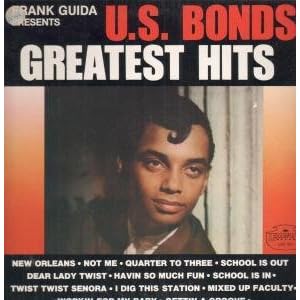
Gary U.S. Bonds Not all rock and roll is party music, and not all party music is rock and roll, but when the two worlds intersect, you get Gary U.S. Bonds. Everything he did, (all his hits, anyway) is about non-stop dancing, drinking, pass the punchbowl, let’s have a good time. And it all sounds like it’s coming from a cheap transistor radio; it doesn’t matter how good the sound system is.

All this comes from a single LP called Greatest Hits and credited to U.S. Bonds, no “Gary” credited anywhere. And Gary is the only part of his name that’s real. It looks to me like this album was realeased c early 1962, as it has all his hits up to that point, and then it was reissued with a slightly changed track listing, including a track from 1967. So it’s all a bit weird.

Gary U.S. Bonds:


New Orleans – Party central, to hear Gary sing it. When did they move the Big Easy to Mississippi? Oh wait, no it’s down “the” Mississippi, not down “to” Mississippi. Sorry. And it’s not easy typing “Mississippi” so many times. From the fall / winter of 1960. Neil Diamond had a crack at this during his tenure with Bang Records.
Not Me – Who then? A hit for The Orlons, not for Gary.
Quarter To Three – Perhaps the ultimate party record. One assumes we are talking about AM, as in time, not radio. This bears no small resemblance to the musical refrain in Runaround Sue by Dion. The rhythm here isn’t frantic, but there’s a syncopation going on that makes it hard to resist. Went to number 1 in the summer of 1961.
School Is Out – The ultimate celebration.. This has none of the destructive glee of Alice Cooper’s School’s Out. From late summer / fall of 1961.
Dear Lady Twist – Notice it’s not Twist Baby, it’s “dear lady,” an allusion, no doubt, to the popularity the twist had won among “adults.” From the winter of 1962.
Havin’ So Much Fun – See? It’s what it’s all about…
School Is In – He celebrates the end of school, he celebrates the start of school. There is no contradiction. But what happens at exam time? From the fall of 1961.
Twist Twist Senora – This is what Chubby Checker spent his entire career aiming to achieve…From the spring of 1962.
I Dig This Station – Let’s turn on the radio… and party!!!!
Mixed Up Faculty – A bit of fun at the teachers’ expense.
Workin’ For My Baby – A bit off topic…
Gettin’ A Groove – That’s what it’s all about…
 
Locations of visitors to this page